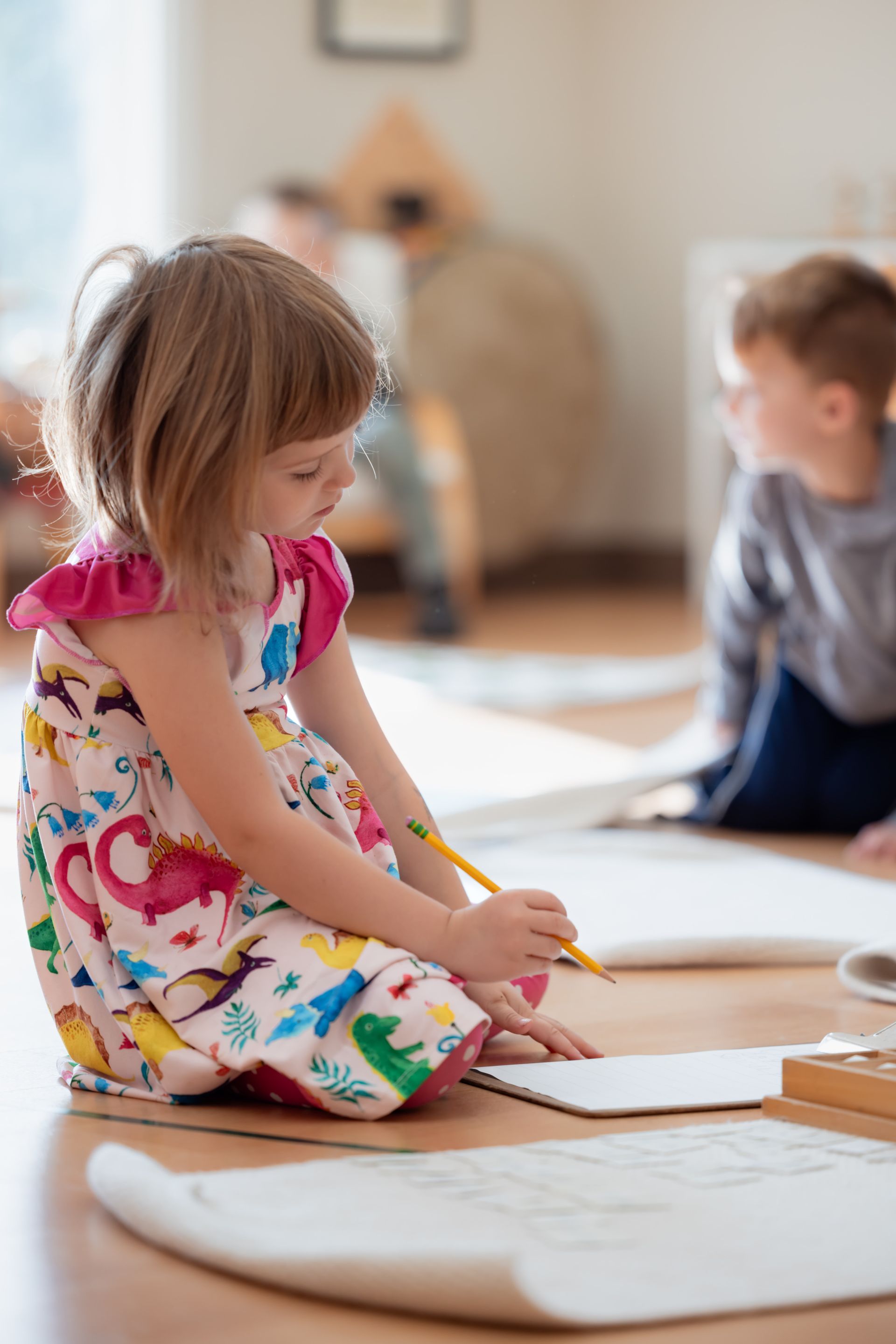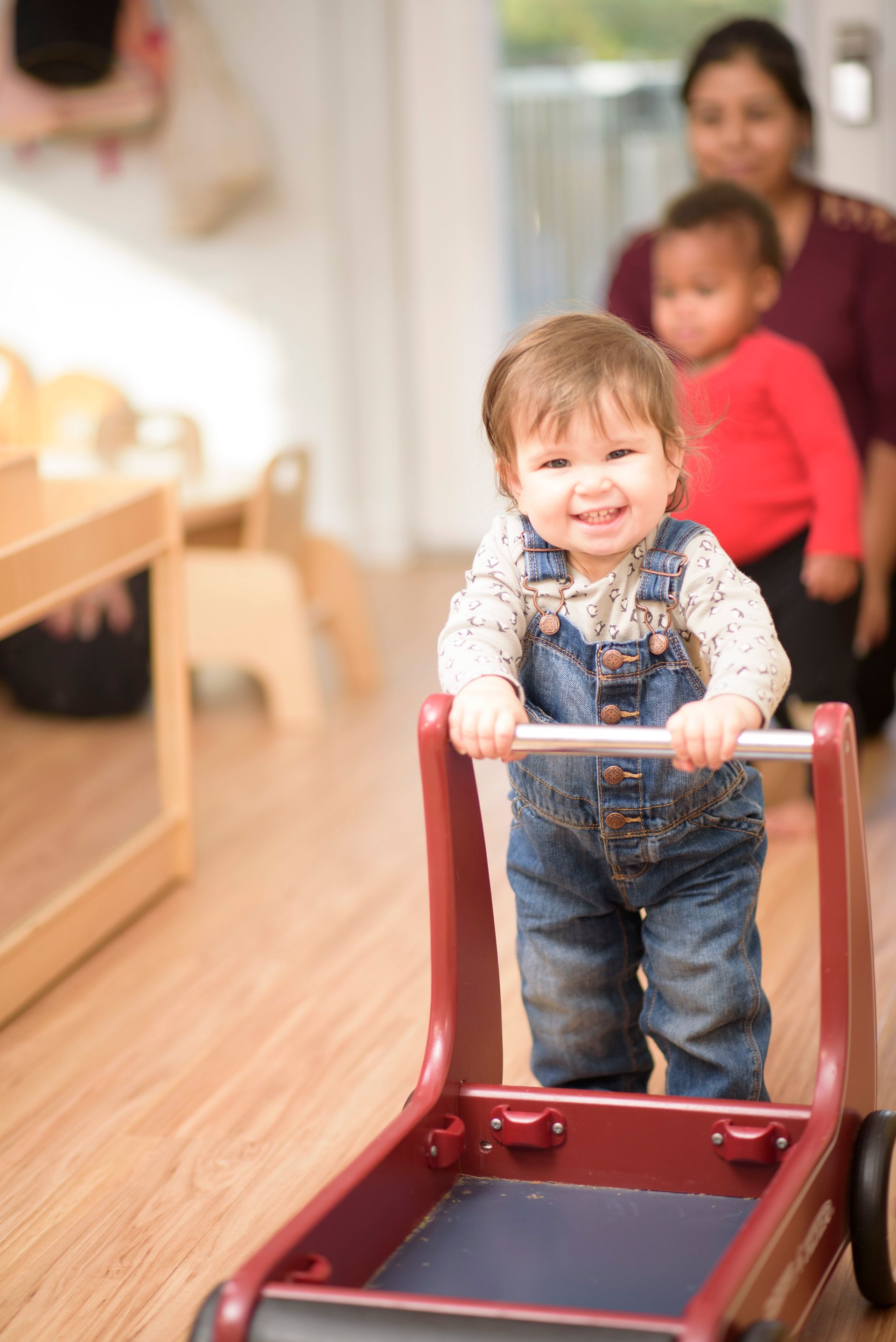
In a Montessori environment, the number three shows up everywhere. We have the three-hour work cycle, three-year age spans, the three-period lesson, and the three-stage learning cycle.
While the number three holds historical significance across many cultures, its presence in a Montessori classroom is grounded in scientific observation. Dr. Maria Montessori observed how children naturally absorb, process, and consolidate information during different stages of human development.
While past articles have explored the three-hour work cycle and multi-age classrooms, this post focuses on how the Three-Period Lesson and the Three-Stage Learning Cycle meet a child's need for internalizing new concepts from infancy through their early years.
The Three-Period Lesson in Early Childhood
Originally developed by French physician Édouard Séguin to help children connect objects with their corresponding terms, the Three-Period Lesson was adapted by Dr. Maria Montessori to help young children link language directly to sensory experience.
In our Nido, Toddler, and Children's House environments, this simple, elegant tool helps children build a rich vocabulary and form clear, lasting mental concepts through three distinct steps:
Period 1: Naming ("This is...")
In this first stage, the guide introduces new language, isolating both the visual or sensory impression and the exact word.
- For Infants and Toddlers: Guides use real objects or small, detailed replicas. Selecting an item from a basket, the guide names it clearly: "This is a sphere." The child holds, touches, and experiences the object, pairing the word with the physical sensation.
- For Abstract Concepts: When introducing qualities like texture, a guide offers two distinct tablets: one with rough sandpaper and one smooth. Placing the child’s fingers on the sandpaper, the guide says: "This is rough."
Period 2: Association and Recognition ("Show me...")
This is the longest and most playful stage of the lesson. The goal is to give the child multiple opportunities to associate the name with the object without putting them on the spot.
The guide rearranges the objects on a work mat and offers light, game-like invitations:
- "Can you place the rough tablet in my hand?"
- "Show me the sphere."
If a child points to the incorrect item, the guide does not issue a verbal correction. Instead, they simply reinforce the vocabulary naturally ("You found the smooth tablet!") and revisit the lesson on another day. This keeps the child's learning experience positive, joyful, and free of pressure.
Period 3: Recall ("What is this?")
In the third period, the guide tests for independent recall. Isolate a single item, the guide gently asks: "What is this?"
Because this step requires the child to retrieve the word entirely from memory, it is typically used with children three and older in the Children's House environment, once language and pronunciation are well established.
How the Learning Cycle Evolves as Children Grow
As children transition from early childhood into their elementary and adolescent years, the fundamental learning process mirrors the three-period framework, but adapts to meet their expanding intellectual capabilities:
- The First Stage (Presentation & Wonder): For older students, lessons begin with a big-picture presentation—a demonstration, a scientific experiment, or a Great Lesson story. Rather than focusing solely on isolated vocabulary, the guide provides just enough information to ignite the child's curiosity and spark independent inquiry.
- The Second Stage (Exploration & Practice): This is the longest phase of learning. Students freely choose follow-up research, collaborative projects, experiments, or creative writing. They test hypotheses, repeat concepts, and deepen their understanding through active practice.
- The Third Stage (Synthesis & Application): As students master a concept, they demonstrate their understanding by applying it in new ways. In elementary spaces, guides discreetly observe this mastery through conversation and student-led work. By adolescence, students share their knowledge through community presentations, published work, or real-world service projects.
Supporting Meaningful Growth at Every Age
Whether an infant in our Nido room is learning the word for a wooden ball or an older child in Children's House is mastering the names of geometric solids, the underlying goal remains the same: supporting the child as they construct their own knowledge with confidence and joy.
We invite you to see this thoughtful approach in action. Visit any of our four Texas campuses (Flower Mound, Las Colinas, McKinney, or Trophy Club)to observe our prepared environments and watch our guides work alongside our students.
Schedule a tour today!